.avif)


_logo%201.svg)


America at 250: Celebration or Spiritual Reckoning?
In 2026, the United States will commemorate 250 years since the signing of the Declaration of Independence.
Across the nation, cities will host commemorations, historical reenactments, and public celebrations marking the birth of the American republic.
Yet beneath the festivities lies a deeper question.
Anniversaries are not merely moments to celebrate the past. They are moments to examine the present.
Two hundred fifty years ago, America was founded on a simple but profound conviction: human rights come from God.
The Founding Fathers held this conviction as an outflow of what it means to be image bearers of God, otherwise known as the Imago Dei.
That idea shaped the culture of the early republic.
Today, however, many Americans no longer share that assumption.
The question facing the nation at its 250th anniversary is therefore larger than politics or patriotism:
Has America remained a nation that recognizes God as the source of liberty—or has it drifted away from that foundation?
What America Looked Like in 1776
To understand how dramatically the culture has changed, we must first understand the world of the founding generation.
The America of the late eighteenth century was deeply shaped by Biblical assumptions about morality, Truth, and human dignity.
The Bible was the most widely distributed book in the colonies. Churches functioned as central hubs of community life. Ministers were among the most respected voices in society.
Public discourse frequently referenced Scripture.
Early American education emphasized moral formation alongside intellectual development with many colonial schools using Biblical texts as part of their instruction.
Even those who were not personally devout often assumed that Christianity provided the moral framework necessary for a stable society.
The founding generation understood liberty differently than many Americans today.
Freedom did not mean independence from moral authority.
Freedom meant the ability to live responsibly within the moral order established by God.
John Adams famously warned:
“Our Constitution was made only for a moral and religious people. It is wholly inadequate to the government of any other.”
The founders believed the survival of the republic depended on virtue—and virtue depended on the Christian faith.
In other words, the American experiment assumed a people who believed they lived under God.
America in 2026: A Culture Redefining Truth
The cultural landscape today looks dramatically different.
Over the past several decades, the nation has experienced one of the most significant worldview shifts in its history.
Several major American institutions began with explicitly Biblical foundations but now operate within largely secular frameworks. Harvard University (1636) was founded by Puritans to train ministers, and Princeton University (1746) began as the College of New Jersey to prepare Presbyterian clergy grounded in Scripture.
Likewise, many early hospitals—including institutions such as Massachusetts General Hospital and numerous Mercy and St. Vincent’s hospitals—were established by Christian leaders and religious orders motivated by biblical commands to care for the sick and poor. Over time, these institutions expanded academically and professionally, gradually moving from explicitly theological missions to modern religiously neutral models.
Earlier generations believed Truth was revealed by God.
Modern culture increasingly teaches that Truth is self-defined.
Earlier generations saw marriage and family as sacred institutions designed by God.
Today, even the definition of marriage and human identity are subjects of cultural debate.
Earlier generations believed moral standards were anchored in Scripture.
Today, morality is often treated as a matter of personal preference.
These changes have reshaped nearly every institution in American life—education, media, entertainment, law, and even many churches.
The result is a society experiencing profound confusion about identity, purpose, and moral authority.
Despite unprecedented technological progress and economic prosperity, many Americans sense that something foundational has been lost.
Cultural Comparison: America Then and Now
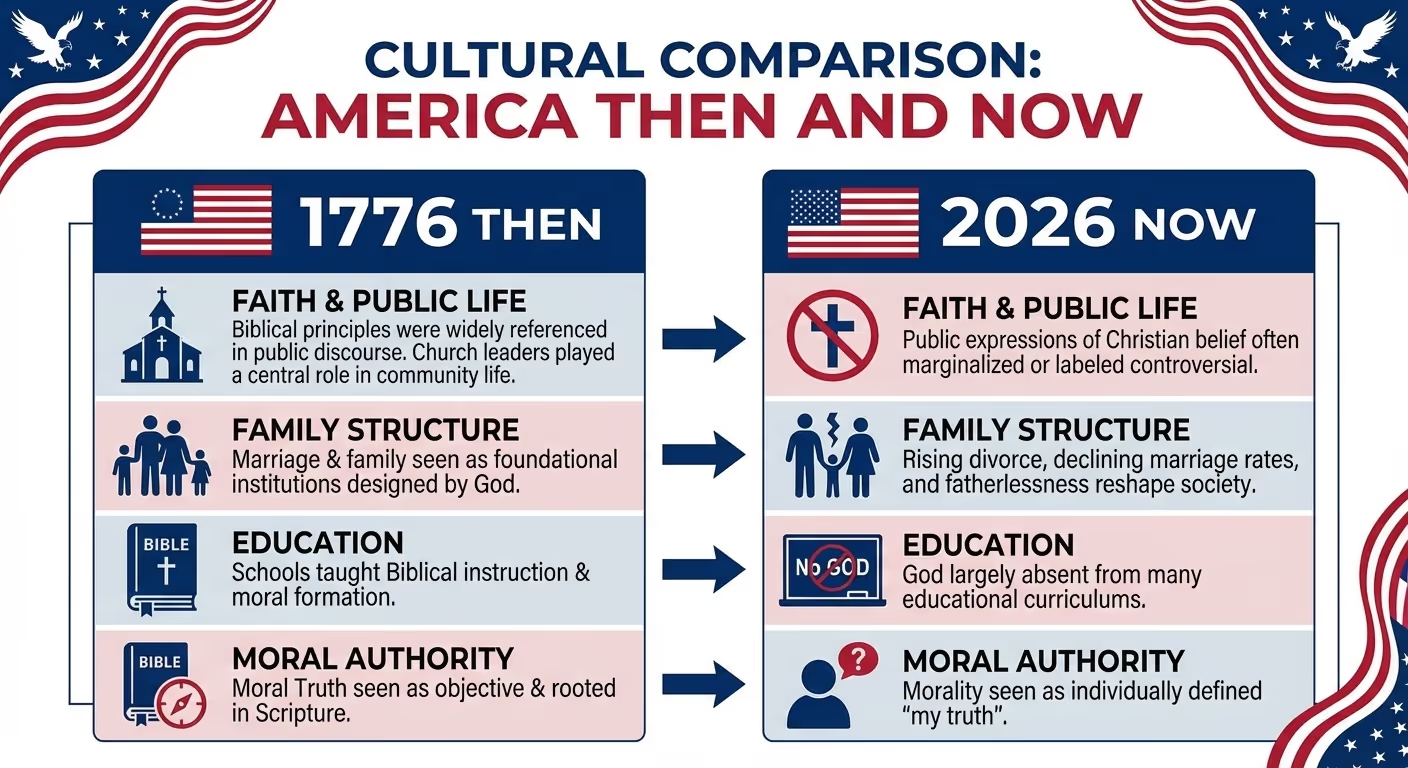
Faith and Public Life
1776:
Biblical principles were widely referenced in public discourse. Church leaders often played a central role in community life.
2026:
Public expressions of Christian belief are frequently marginalized or labeled controversial.
Family Structure
1776:
Marriage and family were widely understood as foundational institutions designed by God.
2026:
Family structures have dramatically shifted. Rising divorce rates, declining marriage rates, and fatherlessness have reshaped the social landscape.
Education
1776:
Early American education frequently included Biblical instruction and moral formation.
2026:
Many educational systems now present a worldview in which God is largely absent from the discussion of Truth and morality.
Moral Authority
1776:
Most Americans believed moral Truth was objective and rooted in Scripture.
2026:
Many now believe morality is defined individually rather than revealed by God.
Research Snapshot: America’s Spiritual Shift
Recent research highlights the scale of cultural transformation.
Barna Group reports that only a small percentage of Americans today hold a consistent Biblical worldview.
Pew Research Center notes a steady rise in Americans who identify as religiously unaffiliated.
Gallup polling shows that U.S. church membership has dropped below 50 percent for the first time in modern history.
These numbers reflect more than declining church attendance.
They reveal a deeper shift in how Americans understand Truth, morality, and authority.
What Happens When a Nation Forgets God
Scripture repeatedly warns about the spiritual trajectory of nations.
Deuteronomy 8:18 declares:
“But remember the Lord your God, for it is He who gives you power to get wealth.”
History shows that societies often begin with humility and gratitude toward God.
But prosperity can lead to pride—and pride can lead to spiritual forgetfulness.
When liberty is detached from its spiritual foundation, it begins to unravel.
Freedom becomes license.
Rights become personal claims of autonomy without moral responsibility.
And self-government becomes increasingly fragile when citizens no longer share a common moral framework.
The founders understood this danger.
That is why early American leaders consistently acknowledged the nation’s dependence on God.
America was never intended to be a theocracy.
But it was clearly founded with the conviction that the nation existed under divine authority.
When God Awakened the Nation
America has faced spiritual decline before—and God has answered with revival.
Timeline of American Awakenings
First Great Awakening (1730s–1740s)
Jonathan Edwards and George Whitefield preached repentance and salvation through Christ. Churches grew, communities were transformed, and a shared spiritual identity emerged among the colonies.
Second Great Awakening (early 1800s)
Revival spread across the young nation. Prayer gatherings multiplied, churches expanded rapidly, and major reform movements addressing slavery and humanitarian issues gained momentum.
Third Awakening (late 1800s)
Urban evangelism and global missionary movements expanded dramatically.
Fourth Awakening (mid-20th century)
Evangelists such as Billy Graham proclaimed the Gospel to millions, and church participation surged across America.
Revival reshapes society because it first reshapes hearts.
America at a Crossroads
As the nation approaches its 250th anniversary, the United States stands at a moment of decision.
The semiquincentennial will be one of the largest national celebrations in American history.
But the deeper significance lies beneath the fireworks and festivities.
Two hundred fifty years after declaring independence, the nation must answer a critical question:
Will America remember the God who gave it liberty?
Scripture reminds us:
“Righteousness exalts a nation, but sin is a reproach to any people.”
— Proverbs 14:34
Political strength cannot replace spiritual health.
Economic success cannot substitute for moral clarity.
Only a renewed reverence for God can sustain a nation across generations.
A Call to Pray for Another Great Awakening
Throughout American history, revival has begun with prayer.
Psalm 85:6 asks a question that echoes across centuries:
“Will You not revive us again, that Your people may rejoice in You?”
If another awakening is to come, it will begin when believers humble themselves before God.
Pray for the Church to stand firmly on the authority and inerrancy of Scripture.
Pray for pastors to proclaim Biblical Truth with courage and clarity.
Pray for families to anchor the next generation in God’s Word.
Pray for national leaders to govern with justice and humility.
And pray that millions of Americans would encounter the transforming power of the Gospel.
Because the ultimate freedom America needs is not political.
It is spiritual.
Jesus declared:
“If the Son sets you free, you will be free indeed.”
— John 8:36
From Independence to Intercession
America will soon celebrate 250 years of independence.
But liberty alone cannot secure the nation’s future.
The fireworks of the semiquincentennial will last only moments.
The spiritual decisions made in this generation will shape the next century.
History will record how America celebrated 250 years.
Heaven will record how the Church responded.
Join the Call to Awakening
AWAKE America is mobilizing believers across the nation to pray for revival during this historic moment.
As America approaches its 250th anniversary:
• Visit the Prayer Room and share your prayer for a Great Awakening.
• Commit to daily intercession for your church and community.
• Attend an upcoming AWAKE America prayer rally and stand with believers praying for national renewal.
• Share this message and invite others to join the call to prayer.
Two hundred fifty years after declaring independence, America stands at a defining moment.
May this anniversary do more than commemorate the past.
May it ignite awakening.

Faith Evans Pearson
Faith Evans Pearson is the AWAKE America Community Manager, progressing the ministry’s mission through creative strategy, social media, digital campaigns, and content—to boldly share the Truth of the Gospel, equip the saints, and encourage believers in the US and abroad.